

Every campaign that reaches a prospect's inbox, feed, or browser passed through a stack of tools that most executives never see. A CRM. An enrichment layer. A content engine. A design tool. A marketing automation platform. A deployment process that is, more often than not, a human being clicking through four browser tabs and a spreadsheet. The average mid-market B2B team now runs 12 or more tools in their martech stack. Enterprise teams run 20 or more. And according to Scott Brinker's 2026 State of Martech report, 90.3% of organizations now use AI agents somewhere in that stack — up from barely measurable adoption just two years ago.
This report benchmarks the modern campaign execution stack as it exists in March 2026. We analyze the tool landscape by category, quantify the hidden cost of integrating these tools, examine the leading platforms in each category, and assess where AI agents fit as the orchestration layer that ties everything together. The data draws from published vendor metrics, industry surveys, analyst reports, and our own observations working with marketing teams across San Francisco and beyond.
The Modern Campaign Execution Stack
A single campaign — say, a targeted ABM email sequence with personalized landing pages — touches a minimum of six tool categories before it reaches its audience. Most teams require more. The canonical stack looks like this:
- Data and Enrichment: Building and enriching target lists (Clay, ZoomInfo, Apollo, Clearbit)
- Content Generation: Writing copy, generating messaging variants, producing long-form assets (Jasper, ChatGPT, Claude, Writer)
- Creative and Design: Producing visual assets, presentations, and landing page designs (Canva, Figma, Gamma)
- Marketing Automation: Configuring workflows, sequences, nurture tracks, and scoring rules (HubSpot, Marketo, Pardot, ActiveCampaign)
- CRM: Managing contact records, deal stages, and account hierarchies (Salesforce, HubSpot CRM)
- Deployment and QA: Actually building and launching the campaign across channels — often manual
- Analytics and Attribution: Measuring results and feeding learnings back (Google Analytics, Bizible, HubSpot reporting)
Each category has a clear market leader and several strong alternatives. The problem is not the quality of individual tools — it is the space between them. Every handoff between tools represents a potential failure point, a manual step, and a tax on the team's time.
The Tool Landscape by Category
The martech landscape in 2026 has consolidated somewhat from the peak of 14,000+ tools tracked by chiefmartec.com, but the core execution stack has actually grown more complex, not less. AI-native tools have entered every category, adding capability but also adding another layer of integration requirements.

The LLM adoption numbers tell the story of how pervasive AI has become in marketing workflows. ChatGPT leads at 97% adoption among marketing teams, followed by Claude at 64%, Perplexity at 57%, and Gemini at 49% (Brinker, 2026 State of Martech). These are not experimental side projects — they are embedded in daily workflows for content generation, research, analysis, and ideation. The 68.9% of organizations that now use content production agents make content the most common use case for AI agents in marketing.
But adoption of individual AI tools does not equal a coherent stack. Most teams use AI point solutions alongside their existing tools, creating yet another layer of manual coordination. The enrichment data comes from Clay. The copy comes from ChatGPT. The design comes from Canva. The automation lives in HubSpot. And someone — usually the most junior person on the team — is responsible for stitching it all together.
The Integration Tax
The hidden cost of the modern martech stack is not the tools themselves. It is the labor required to connect them.
We estimate that marketing operations teams spend 30 to 40 percent of their time on tool coordination — moving data between platforms, reformatting outputs from one tool to fit the inputs of another, debugging broken integrations, and manually executing steps that should be automated but are not. This is the integration tax, and it is the single largest source of inefficiency in campaign execution.
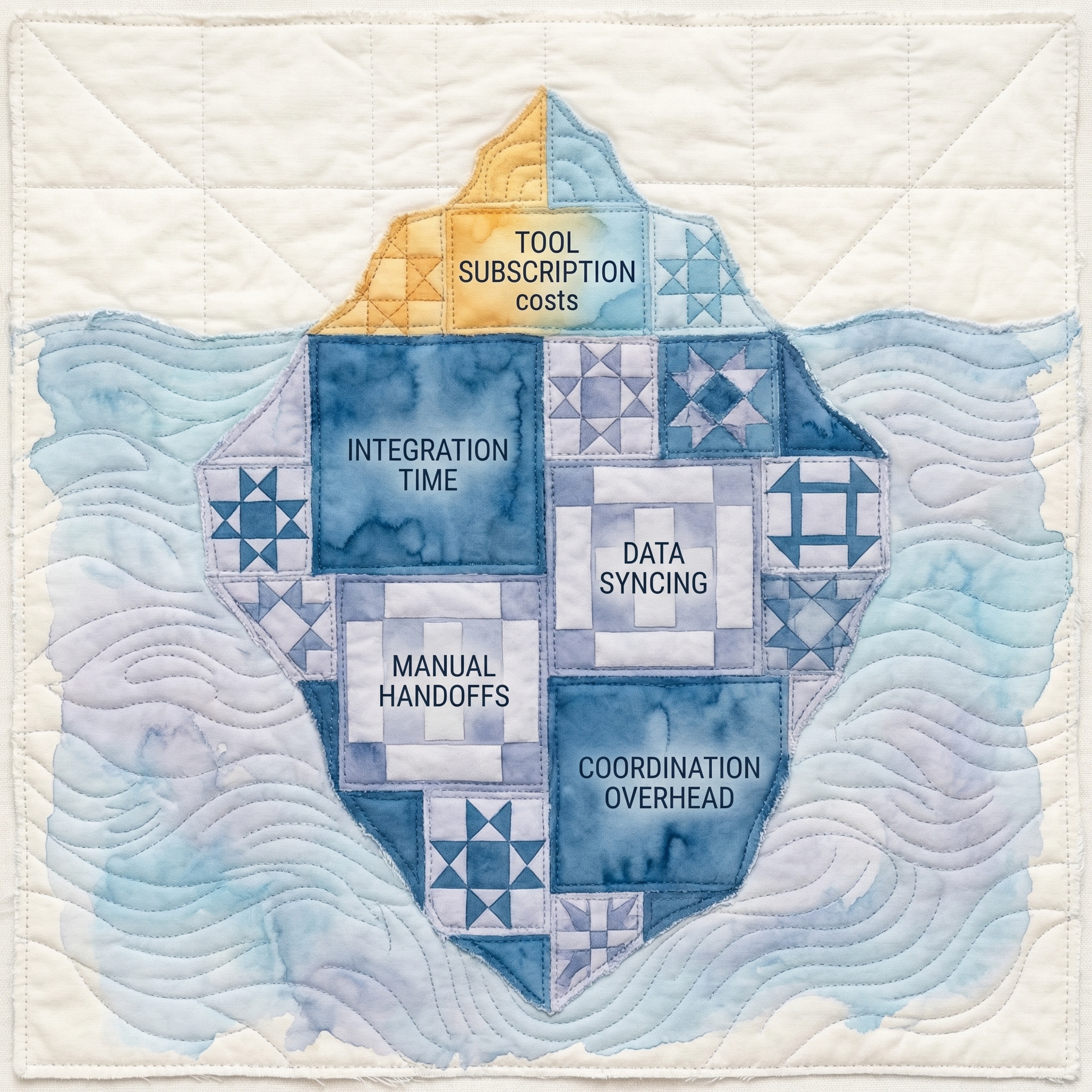
The integration tax manifests in several ways. Data formatting. An enrichment tool outputs a CSV with 47 fields. The MAP accepts 23 fields in a different schema. Someone has to map, transform, and validate the data every time. Asset handoffs. A designer finishes a template in Canva. Someone downloads it, reformats it for the email builder, uploads it, and tests rendering. Workflow configuration. The strategy team defines the campaign logic in a brief or spreadsheet. An ops person translates that logic into HubSpot workflows, Marketo programs, or Pardot engagement studios — manually, every time. QA and testing. No single tool provides end-to-end QA. Teams cobble together Litmus for email rendering, manual checks for landing pages, and spreadsheet-based reviews for workflow logic.
"The tools are not the bottleneck. The seams between the tools are the bottleneck. Every handoff is a chance for delay, error, or lost context — and a modern campaign has dozens of handoffs."
For a mid-market team running 8 to 12 campaigns per month, the integration tax translates to roughly 1.5 to 2 full-time employees worth of effort spent on coordination rather than strategy or creative work. For enterprise teams, the number is higher — often 3 to 5 people whose primary function is connecting tools rather than driving outcomes.
Category Deep Dives
Enrichment: Clay and the Waterfall Model
Clay has emerged as the category-defining platform in data enrichment, reaching a $3.1 billion valuation by fundamentally rethinking how enrichment works. Instead of relying on a single data provider, Clay aggregates 150 or more data providers through a waterfall enrichment model — querying multiple sources in sequence until the desired data point is found. The result is dramatic: email find rates jump from roughly 40% with a single provider to 78% with waterfall enrichment across multiple sources.
The waterfall model has implications beyond find rates. It means that the quality of enrichment is no longer determined by which vendor you chose — it is determined by how many vendors you can orchestrate and how intelligently you sequence the queries. Clay's table-based interface makes this orchestration accessible to non-technical users, which is why it has become the de facto standard for revenue operations teams building targeted campaign lists.
The gap in the Clay workflow is what happens after enrichment. The data is clean, verified, and ready for activation. But "activation" still means exporting a CSV, importing it into your MAP, building the campaign assets, configuring the sequences, and launching — all manually. Clay solves the data problem brilliantly. It does not solve the deployment problem.
Creative: Canva, Figma, and Gamma
The creative tool landscape has been transformed by AI in 2026. Canva's AI Magic Design generates on-brand templates from text prompts, available at $40 per user per month on their Teams plan. Figma has absorbed most of the web design workflow for agencies and in-house teams. And Gamma — now rumored at a $12 billion or more valuation — just launched Gamma Imagine, bringing image generation directly into their presentation and document platform.
The common pattern across all three tools is the same: they have made the creation of visual assets dramatically faster while leaving the deployment of those assets unchanged. A marketer can generate a landing page design in Gamma in minutes. Converting that design into a functional, tracked, integrated landing page inside their MAP still takes hours or days. Canva can produce 20 email header variants in seconds. Selecting, exporting, uploading, and testing those variants across email clients is still manual work.
The creative bottleneck has shifted. In 2023, the bottleneck was producing visual assets — teams waited days or weeks for designers. In 2026, the bottleneck is deploying visual assets. AI made creation fast. Deployment is still slow.
Content: Jasper, ChatGPT, and the Multi-Model Stack
Jasper has evolved significantly from its origins as an AI copywriting tool. In 2026, Jasper offers 100 or more agents and full content pipelines built on a multi-model architecture. Rather than relying on a single LLM, Jasper routes tasks to the most appropriate model — using different models for different content types, brand voice calibration, and output formats. This multi-model approach produces higher-quality, more consistent outputs than any single model alone.
ChatGPT's 97% adoption rate among marketing teams makes it the most widely used AI tool in the stack, though its usage pattern differs from Jasper's. Where Jasper is embedded in production workflows with brand guidelines and approval processes, ChatGPT is used more flexibly — for brainstorming, first drafts, research summaries, and ad hoc content needs. Claude, at 64% adoption, occupies a similar space with particular strength in long-form content and nuanced messaging where its extended context window and reasoning capabilities provide an edge.
The content generation category is the most AI-disrupted segment of the marketing stack. The volume of content that a team can produce has increased by an order of magnitude. But content production and content deployment remain separate problems. Jasper generates the copy. Who deploys it?
Marketing Automation Platforms: HubSpot and Marketo
HubSpot and Marketo remain the two poles of the MAP market. HubSpot, with its Breeze AI layer, has introduced over 200 AI features and Breeze agents purpose-built for SMB and mid-market teams. These agents handle tasks like lead scoring, content recommendations, and basic workflow suggestions — reducing the technical expertise required to operate the platform. Marketo continues to dominate enterprise marketing automation with AI-powered predictive features for audience segmentation, content personalization, and engagement scoring.
Both platforms have invested heavily in AI features, but their AI capabilities are largely internal — they optimize what happens within the platform. The challenge remains getting the right data, content, and creative assets into the platform in the first place, and ensuring that what comes out is properly deployed across channels. A HubSpot Breeze agent can suggest an optimal send time. It cannot pull the enriched list from Clay, import the Jasper copy, attach the Canva creative, build the landing page, and configure the multi-step workflow. That orchestration still requires a human — or an external agent.
Deployment: The Last Mile
Deployment remains the least automated segment of the campaign execution stack. In most organizations, deployment is a person. Someone who knows how to navigate the MAP, who understands the naming conventions, who remembers to set UTM parameters, who checks the suppression lists, who tests the emails in Litmus, who verifies the landing page loads correctly on mobile. This person is the single most valuable and most overwhelmed member of the marketing team.
"We have more content than we can deploy. We have more ideas than we can execute. We have more data than we can activate. The constraint is not creation — it is the last mile."
This deployment bottleneck is why most marketing teams run far fewer campaigns than their strategy and content capabilities would allow. The real cost of campaign execution is not the tools or the content — it is the deployment labor that connects everything.
Where AI Agents Fit: The Orchestration Layer
The 90.3% adoption figure for AI agents in martech (Brinker, 2026) is deceptive if you do not examine where those agents are deployed. The vast majority — 68.9% — are content production agents. They live within a single tool and optimize a single step. They are powerful but narrow. They make individual tools better without addressing the space between tools.
The emerging category is the orchestration agent — an AI agent that operates across the entire stack, connecting enrichment to content to creative to automation to deployment. This is the layer that the integration tax lives in. It is the layer where 30 to 40 percent of marketing ops time disappears into manual coordination.

Orchestration agents differ from in-tool agents in three fundamental ways. First, they operate across multiple platforms via APIs and browser-level interactions, rather than being confined to a single tool. Second, they handle multi-step workflows that span the full campaign lifecycle — from enrichment through deployment — rather than optimizing a single task. Third, they maintain context across the entire workflow, understanding how a change in the enrichment criteria affects the content strategy, which affects the creative assets, which affects the MAP configuration.
The analogy to software development is CI/CD pipelines. Individual developer tools — IDEs, linters, test runners — each handle one step well. CI/CD is the orchestration layer that connects them into an automated pipeline. AI orchestration agents are the CI/CD of marketing.
Where the 90.3% breaks down: Most AI agent adoption is within individual tools — content agents, scoring agents, personalization agents. The orchestration layer — agents that connect the full stack — is still early. This is the highest-leverage gap in the 2026 martech stack.
Build vs Buy vs Agent: A Decision Framework
Marketing leaders in 2026 face a three-way decision for every gap in their stack: build a custom integration, buy a platform that consolidates multiple functions, or deploy an AI agent to orchestrate across existing tools.
Build (custom integrations). This means engineering resources — APIs, webhooks, middleware like Zapier or Workato, and custom scripts. The advantage is full control and exact fit to your workflow. The cost is ongoing maintenance, fragility (APIs change, schemas evolve), and the opportunity cost of engineering time. Build makes sense when you have a unique workflow that no vendor supports and in-house engineering capacity to maintain the integration indefinitely.
Buy (consolidated platforms). This means choosing a platform that handles multiple categories — HubSpot's all-in-one approach, for example. The advantage is reduced integration complexity and a single vendor relationship. The cost is compromising on best-of-breed capability in individual categories and vendor lock-in. Buy makes sense when simplicity matters more than optimization and your team does not have the sophistication to manage a multi-tool stack.
Agent (AI orchestration). This means deploying an AI agent layer that connects your existing best-of-breed tools. The advantage is keeping the tools you already know and love while eliminating the manual coordination between them. The cost is trusting an agent with campaign-critical workflows and the learning curve of a new paradigm. Agent makes sense when you have invested in strong individual tools and the bottleneck is the space between them — which, for most teams, it is.
The decision is not mutually exclusive. Most organizations will use a combination of all three approaches. But the directional trend is clear: the agent approach is gaining share because it solves the integration tax without requiring teams to abandon their existing investments.
2026 Stack Recommendations by Company Size
Early-Stage (Under 50 Employees)
Keep it simple. HubSpot CRM plus Marketing Hub handles CRM, automation, and basic analytics in a single platform. Use ChatGPT or Claude for content generation. Use Canva for creative. Use Clay Starter for enrichment when you begin outbound. At this stage, the integration tax is low because volume is low. Your priority is establishing repeatable campaigns, not optimizing the stack.
Mid-Market (50 to 500 Employees)
This is where the integration tax becomes material. You are running 8 to 15 campaigns per month across multiple segments and channels. The stack expands: Clay for enrichment, Jasper or ChatGPT for content at scale, Canva or Figma for creative, HubSpot or Marketo for automation, Salesforce for CRM. At 12 or more tools, you need either a dedicated marketing ops person or an AI orchestration layer to manage the coordination. The hidden cost of manual deployment is now your primary constraint.
Enterprise (500+ Employees)
At enterprise scale, you are managing 20 or more tools across multiple regions, brands, and business units. Marketo or HubSpot Enterprise anchors the automation layer. Salesforce is the CRM. Clay or ZoomInfo powers enrichment. You likely have Jasper's enterprise plan for content governance. The integration tax at this level consumes 3 to 5 FTEs worth of coordination effort. The question is not whether to deploy orchestration agents — it is how quickly you can deploy them and how much of the manual coordination you can eliminate. Every month of delay costs headcount equivalent that could be redeployed to strategy and creative work.
The Stack Is Solved. The Seams Are Not.
The 2026 campaign execution stack is remarkable in its individual components. Clay's waterfall enrichment finds data that was invisible two years ago. Jasper's multi-model content pipelines produce publication-ready copy at scale. Canva and Gamma have democratized visual design. HubSpot and Marketo offer AI-augmented automation that would have seemed science fiction in 2020.
But the stack is not a single machine. It is a collection of excellent individual tools connected by manual labor, spreadsheets, and hope. The 30 to 40 percent integration tax is real. The deployment bottleneck is real. The gap between what teams can create and what they can actually launch is real.
The organizations that will outperform in 2026 are not the ones with the best individual tools. They are the ones that solve the orchestration problem — connecting their stack into a continuous pipeline from enrichment to deployment. Whether through custom integrations, consolidated platforms, or AI orchestration agents, the competitive advantage now lives in the seams.
The tools are solved. The connections between them are the last frontier.