

Something shifted in 2025 that was easy to miss if you were watching quarterly earnings instead of staffing plans. Agencies started cutting. Not the kind of cuts you explain with "restructuring" or "macro headwinds" — the kind of cuts that come from realizing that a significant share of what you sell can now be done by software. Forrester's 2026 predictions quantify the shift: a 15% reduction in agency headcount this year, following an 8% cut in 2025. That is not a blip. That is a structural repricing of what agencies are worth.
At the same time, Gartner projects $201.9 billion in global agentic AI spending for 2026 — capital flowing into autonomous systems that can execute multi-step workflows without human intervention. The global marketing automation market is on pace to grow from $47 billion in 2025 to $81 billion by 2030, compounding at 11.5% annually. And 94% of marketers now report using AI in some form within their workflows.
The question is no longer whether AI will reshape marketing operations. The question is what survives the transition — and what does not.
1. The Numbers Are In
Let us start with what the data actually says, because the narrative has gotten ahead of the evidence in some areas and behind it in others.
Forrester's headcount prediction is not a forecast about AI replacing creativity. It is a forecast about AI replacing execution. The 15% cut targets the roles that agencies have historically staffed in volume: campaign builders, media buyers handling routine optimization, reporting analysts pulling data from dashboards, and project managers coordinating handoffs between teams. These roles exist because the tools agencies use require human operators. When the tools operate themselves, the humans become overhead.
The $201.9 billion in agentic AI spending reflects a market that has moved past proof-of-concept. Enterprises are not experimenting with agents — they are deploying them into production workflows with committed budgets and measurable ROI targets. In marketing specifically, the spending is concentrated on systems that can take a campaign brief and produce deployed assets: emails built and configured in HubSpot, landing pages live in Webflow, ad creative uploaded and targeted in Meta and Google.
The acceleration curve: Forrester measured 8% agency headcount reduction in 2025. They project 15% for 2026. That is not linear growth — it is compounding. If the pattern holds, we are looking at 25-30% cumulative reduction by end of 2027. The agencies that treat this as a temporary cycle rather than a permanent structural change will not survive it.
The parallel to what happened in software development is instructive. Two years ago, coding agents were interesting demos. Today, 95% of developers use AI coding agents weekly. The adoption curve in marketing is following the same trajectory, just 18 months behind. The $200 billion agentic AI bet is landing on marketing as its next major frontier.
2. What Agencies Actually Do (and What Is Automatable)
To understand what gets replaced, you have to decompose what agencies actually deliver. Not what they say they deliver — strategy, creative vision, brand stewardship — but what the invoices actually cover.
A typical agency engagement breaks down roughly as follows:
- Strategy and planning: 10-15% of billed hours. Audience research, campaign architecture, channel selection, messaging frameworks.
- Creative development: 20-25% of billed hours. Copywriting, design, video production, brand asset creation.
- Campaign execution: 35-45% of billed hours. Building emails, configuring automations, setting up ad campaigns, creating landing pages, QA testing, deployment.
- Reporting and optimization: 15-20% of billed hours. Pulling performance data, building reports, making recommendations for iteration.
- Project management and communication: 10-15% of billed hours. Status meetings, email threads, revision cycles, timeline management.
Look at that breakdown. Campaign execution and reporting together account for 50-65% of what agencies bill for. These are the tasks that AI agents handle today — not theoretically, not in demos, but in production deployments. The execution layer is being automated. The coordination layer is being compressed. What remains is strategy and creative direction, which represent a fraction of current agency revenue.
This is the economic problem agencies face: the high-value work they want to sell represents 10-15% of what clients actually pay for. The other 85% is execution and coordination that agents increasingly handle faster and cheaper.
3. The SaaStr Case Study: From 9 Humans to 1.2 Humans + 20 Agents
The most concrete public case study of this transition comes from Jason Lemkin at SaaStr — one of the most influential voices in B2B SaaS. In late 2025, Lemkin documented what happened when SaaStr replaced most of its marketing execution team with AI agents.
The numbers are stark. SaaStr went from 8-9 humans handling marketing operations to 1.2 humans plus 20 AI agents. The agents handle email personalization, campaign deployment, content creation, and outbound sequencing. The remaining human handles strategy, quality oversight, and the creative decisions that require brand judgment.
The performance results challenge the assumption that replacing humans means accepting lower quality:
- Email volume: 70,000 hyper-personalized emails per campaign, up from 7,000 human-written emails previously — a 10x increase.
- Revenue impact: The AI-generated outbound directly generated 15% of SaaStr London conference revenue.
- Personalization depth: Each email is tailored to the recipient's company, role, recent activity, and likely pain points — a level of personalization that was economically impossible with human writers.
"Classic email-based SDRs will be 90% displaced within 12 months. Not because the humans are bad at it — because agents do it at a scale and personalization depth that humans physically cannot match." — Jason Lemkin, SaaStr

The cost comparison is what makes this irreversible. SaaStr's effective cost per campaign dropped by roughly 80% while output increased 10x. No amount of agency efficiency improvement can compete with that economics. This is not a story about AI being "pretty good" — it is a story about a fundamentally different cost structure that makes the old model economically unviable.
4. Timeline Compression: 6 Weeks to 6 Hours
Cost is only half the equation. The other half is speed.
A traditional agency campaign timeline looks something like this: two weeks for briefing and strategy, one week for creative development, one week for revisions, one week for build and QA, one week for deployment and monitoring. Six weeks from brief to live, if everything goes smoothly. In practice, revision cycles and approval bottlenecks push most campaigns to eight or ten weeks.
With agent-driven execution, the timeline compresses dramatically. Research from Robotic Marketer and internal data from teams deploying marketing agents show that campaigns reach market 75% faster with AI automation. But that understates the reality for fully agent-driven workflows, where brief-to-deployment can happen in hours rather than weeks.
The compression happens because agents eliminate the handoffs that consume most of the calendar time in traditional execution. There is no waiting for the copywriter to finish so the designer can start. No staging environment review meeting. No back-and-forth email thread about button colors. The agent takes the brief, generates the assets, configures the tools, runs QA, and deploys — in a single automated workflow.
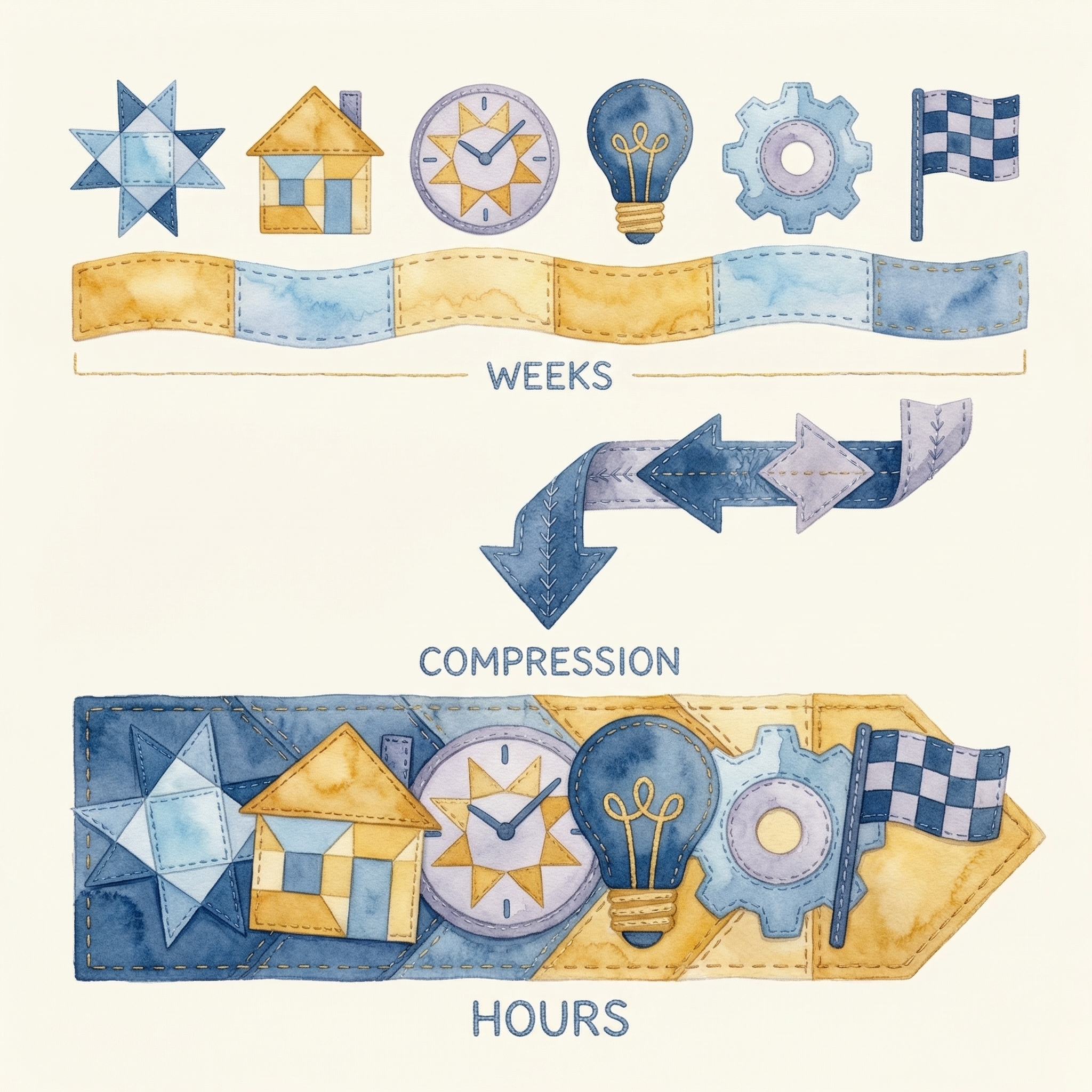
This speed advantage compounds. A team that can deploy in hours instead of weeks does not just run campaigns faster — they run fundamentally more campaigns. They can test more messaging variants, target more segments, and iterate based on performance data in real time. The gap between agency timelines and agent timelines is not incremental — it is categorical.
The throughput math: An agency running 6-week cycles can deliver roughly 8 campaigns per quarter per account. An agent-driven workflow running in hours can deliver 50-100 campaigns in the same period. When you compete on learning velocity — how fast you can test, measure, and iterate — the team running 10x more experiments wins. Every time.
5. The Headcount Shift: Fewer People, More Output
Forrester's 15% cut is the industry average. The actual variance across agencies is enormous. Some agencies — particularly those focused on execution-heavy services like email marketing, paid media management, and marketing operations — are seeing 30-40% headcount reductions as agents absorb the work. Others, focused on strategic consulting and high-end creative, have barely been touched.
The pattern is consistent across the data: agencies that automate are reclaiming 5-10 hours per account manager per week. That time was previously spent on manual campaign setup, reporting pulls, and coordination overhead. Freed from execution, account managers can serve more clients at higher quality — or the agency can serve the same number of clients with fewer account managers.
Most agencies are choosing the latter. When your competitors are cutting rates because their cost structure just dropped 40%, you either match their cost structure or lose the clients. That is the headcount pressure Forrester is measuring.
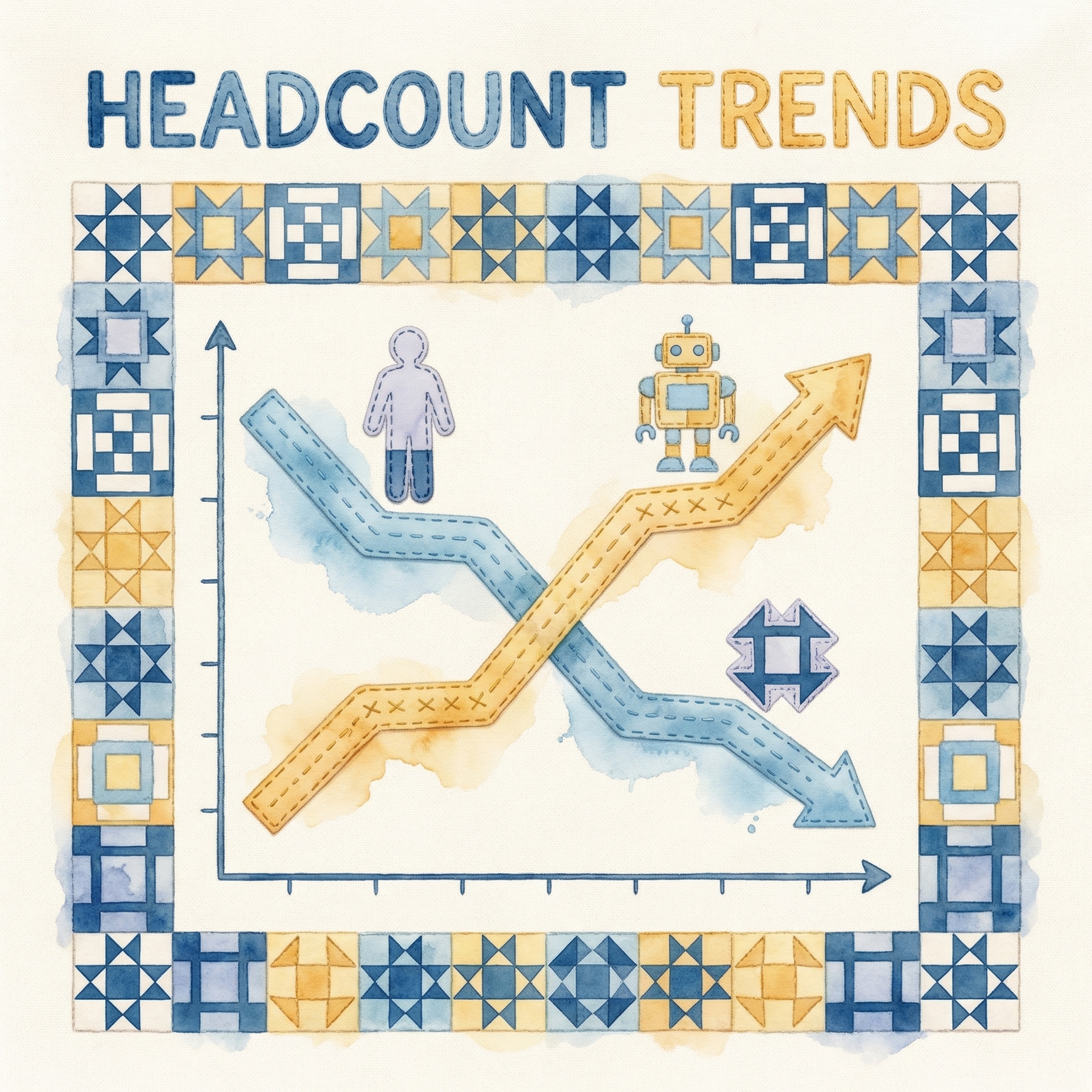
The displacement is not evenly distributed across roles. The most affected positions are campaign execution specialists, junior media buyers handling routine optimization, marketing operations coordinators, and reporting analysts. The least affected are senior strategists, creative directors, client relationship managers, and specialists in emerging or complex channels where agent capabilities are still immature.
This creates a barbell effect in agency staffing: a small number of senior strategic and creative roles at the top, a large layer of AI agents in the middle, and a thin layer of technical operators managing the agent infrastructure at the bottom. The thick middle layer of mid-career execution professionals — the backbone of traditional agency staffing — is the layer being compressed.
6. What Survives
The death of the agency is not literal. It is the death of the agency as a labor arbitrage business. What survives is what cannot be automated — and understanding the boundary matters for anyone making hiring, vendor, or career decisions right now.
Strategic thinking survives. Understanding a client's competitive position, identifying underserved audience segments, designing the campaign architecture that connects business objectives to channel tactics — this requires judgment, context, and the kind of nuanced understanding that agents do not yet possess. A CMO hiring an agency for strategic guidance is buying human judgment. That value proposition is intact.
Relationship management survives. Clients pay agencies partly for execution and partly for the comfort of having a trusted partner who understands their business. The relationship layer — the account director who has been with the client for three years and knows the internal politics, the brand sensitivities, the CEO's pet peeves — is not automatable. It is also not scalable, which limits how much of the revenue mix it can represent.
Novel creative direction survives. Developing a genuinely new brand campaign, producing high-end video content, crafting a messaging strategy that repositions a company in its market — these creative acts require taste, cultural awareness, and originality that agents do not demonstrate at a professional level. The creative director is safe. The junior designer executing the creative director's vision in twenty ad sizes is not.
"The agencies that survive will look nothing like today's agencies. They will be ten people and a hundred agents, selling outcomes instead of hours. The ones still selling hours in 2027 will not exist in 2028."
7. The New Model: AI-Native Agencies
What replaces the traditional agency is already visible in early form. A new category of firm is emerging — call them AI-native agencies — that are built from the ground up around agent-driven execution. Based in markets like San Francisco and increasingly distributed globally, these firms share several characteristics that distinguish them from traditional agencies trying to bolt AI onto existing processes.
Outcome pricing instead of hourly billing. Traditional agencies sell time. AI-native agencies sell deployed campaigns, qualified leads, or pipeline generated. The pricing model shifts from input-based (hours worked) to output-based (results delivered). This is possible because agent-driven execution has predictable costs and measurable outputs.
Speed as a differentiator. When brief-to-deployment takes hours instead of weeks, speed itself becomes a competitive advantage. AI-native agencies can offer same-week campaign deployment as a standard service level — something that would require a war room and weekend work at a traditional agency.
Compound learning across clients. Every campaign an agent deploys generates performance data that improves future campaigns. AI-native agencies accumulate this learning across their entire client base, creating a data advantage that grows with every engagement. A traditional agency's institutional knowledge walks out the door when employees leave. An AI-native agency's institutional knowledge lives in the agent's training data and optimization history.
Radical transparency. When agents execute campaigns, every step is logged, timestamped, and auditable. Clients can see exactly what was done, when, and what it cost. This level of transparency is impossible in a traditional agency where execution happens across multiple people's inboxes and design tools. The opacity that allowed agencies to bill 40 hours for 15 hours of actual work disappears when agents produce complete execution logs.
8. What This Means for Marketing Leaders
If you are a CMO, VP of Marketing, or head of demand generation, the implications of this shift are concrete and immediate.
Audit your current agency spend against the automation frontier. Take your last three months of agency invoices and categorize every line item as strategy, creative, execution, or reporting. For most companies, 50-65% of the total will fall into execution and reporting — the categories being automated. That is the budget you should be evaluating for agent-driven alternatives.
Do not wait for your agency to figure this out. Most traditional agencies are in denial about the speed of this transition. They are experimenting with AI tools internally but have no incentive to pass the cost savings to clients — doing so would cannibalize their own revenue. You will need to either push your agency to adopt agent-driven execution (with corresponding rate reductions) or find a partner that is already built on the new model.
Redefine what you hire agencies for. The valuable agency relationship of 2027 looks like this: a small team of senior strategists and creative directors who understand your business deeply, supported by an agent infrastructure that can execute any campaign they design within hours. You are hiring for judgment and taste, not for hands on keyboards.
Build internal agent competency. Whether you work with an AI-native agency or build internal capabilities, your team needs to understand how to brief agents, evaluate agent output, and manage agent-driven workflows. This is a new skill set — closer to product management than traditional marketing management — and the talent market for it is thin. Start developing it now.
The 15% headcount reduction Forrester predicts for 2026 is the beginning, not the end. The structural economics are too clear and the performance advantages too large for this to stabilize at a modest trim. Within three years, the agency model as we have known it for decades — large teams of execution professionals billing hourly rates — will be unrecognizable. What replaces it will be leaner, faster, and measurably more effective. The transition is already underway. The only question is whether you lead it or get dragged through it.