

Something remarkable happened in software engineering between 2024 and 2026. AI coding agents went from curiosity to cornerstone. According to a widely cited Pragmatic Engineer survey, 95% of developers now use AI coding tools on a weekly basis. Seventy-five percent rely on them for at least half their work. And 56% report that AI handles 70% or more of their actual coding output. These are not incremental productivity gains. This is a structural transformation of how software gets built.
Now the question everyone in San Francisco and beyond is asking: what gets transformed next? The answer, increasingly, is marketing. Not the copy-generation layer that ChatGPT already handles. The full execution pipeline — from strategic brief to live, deployed, multi-channel campaign running inside HubSpot, Marketo, Salesforce, and the dozens of other platforms that comprise a modern marketing stack. Gartner projects $201.9 billion in agentic AI spending in 2026, and a disproportionate share of that capital is chasing the same thesis: the deployment gap that coding agents have closed for software is now closable for marketing.
This report examines why code was the first domain to fall, why marketing is structurally harder, and why the infrastructure catching up in 2025-2026 makes campaign execution the single largest remaining agentic AI opportunity.
1. The Coding Agent Revolution: What Happened 2024-2026
To understand where marketing is going, you have to understand what just happened in code. The timeline moved faster than almost anyone predicted.
In early 2024, AI coding tools were primarily autocomplete engines — GitHub Copilot suggesting the next line, developers accepting or rejecting in real time. By mid-2024, the paradigm had shifted to agentic workflows: tools that could take a task description, plan an implementation, write multiple files, run tests, and iterate on failures without human intervention. OpenAI's Codex, released as a research preview, could open pull requests that passed CI pipelines and merged without a single human edit.
Then came 2025. Anthropic released Claude Code in May 2025, which rapidly became the most-used AI coding tool in the industry. Claude Code did not just generate code — it operated inside the developer's terminal, understood project context across thousands of files, ran builds and tests, and committed directly to version control. Cursor, the AI-native IDE, shipped a major agent update in February 2026 (reported by CNBC) that embedded autonomous coding workflows directly into the editing environment. The result was a new default: developers describe what they want, and the agent writes, tests, and ships it.
The quality gap is real but narrowing. Research from GitClear and others found that AI-generated code has 1.7 times more issues than human-written code and three times more readability problems. But these numbers improve with every model generation, and the speed advantage is so dramatic — hours of work compressed into minutes — that teams accept the tradeoff and invest in stronger review processes rather than abandoning the tools.
"We're not debating whether to use AI coding agents anymore. We're debating how much human review is appropriate for the code they produce. That's a fundamentally different conversation than the one we were having eighteen months ago." — engineering lead at a Fortune 500 company, speaking at a 2026 developer conference
The key insight is not that AI writes perfect code. It is that the entire infrastructure around code — version control, testing, CI/CD, code review, rollback mechanisms — creates a safety net that makes autonomous deployment viable even when the AI makes mistakes. The system catches errors before they reach users. This infrastructure is what marketing lacks.
2. Why Code Was First: The Structural Advantages
Code was the natural first domain for agentic AI not because software engineers are more innovative than marketers, but because the deployment surface for code has three properties that marketing lacks entirely.
Universal version control. Every software project on earth uses git. The interface is identical whether you are working on a two-person startup or a 10,000-engineer enterprise: clone, branch, commit, push, merge. An AI agent trained on one codebase can operate on any codebase because the deployment primitive is standardized. There is no "HubSpot version of git" and "Marketo version of git" with different APIs, different data models, and different deployment semantics.
Automated testing. Software has a verification layer that is entirely machine-readable. Unit tests, integration tests, end-to-end tests — all produce binary pass/fail signals that an AI agent can consume and act on. When Claude Code writes a function and the test suite fails, it reads the error, modifies the code, and tries again. This feedback loop is what enables autonomy. Without it, every output requires human inspection.
Programmable deployment. A git push origin main triggers a CI/CD pipeline — build, test, deploy — that executes entirely through APIs and command-line interfaces. No human clicks through a GUI. No one drags and drops components into a visual editor. The entire path from code to production is machine-addressable.
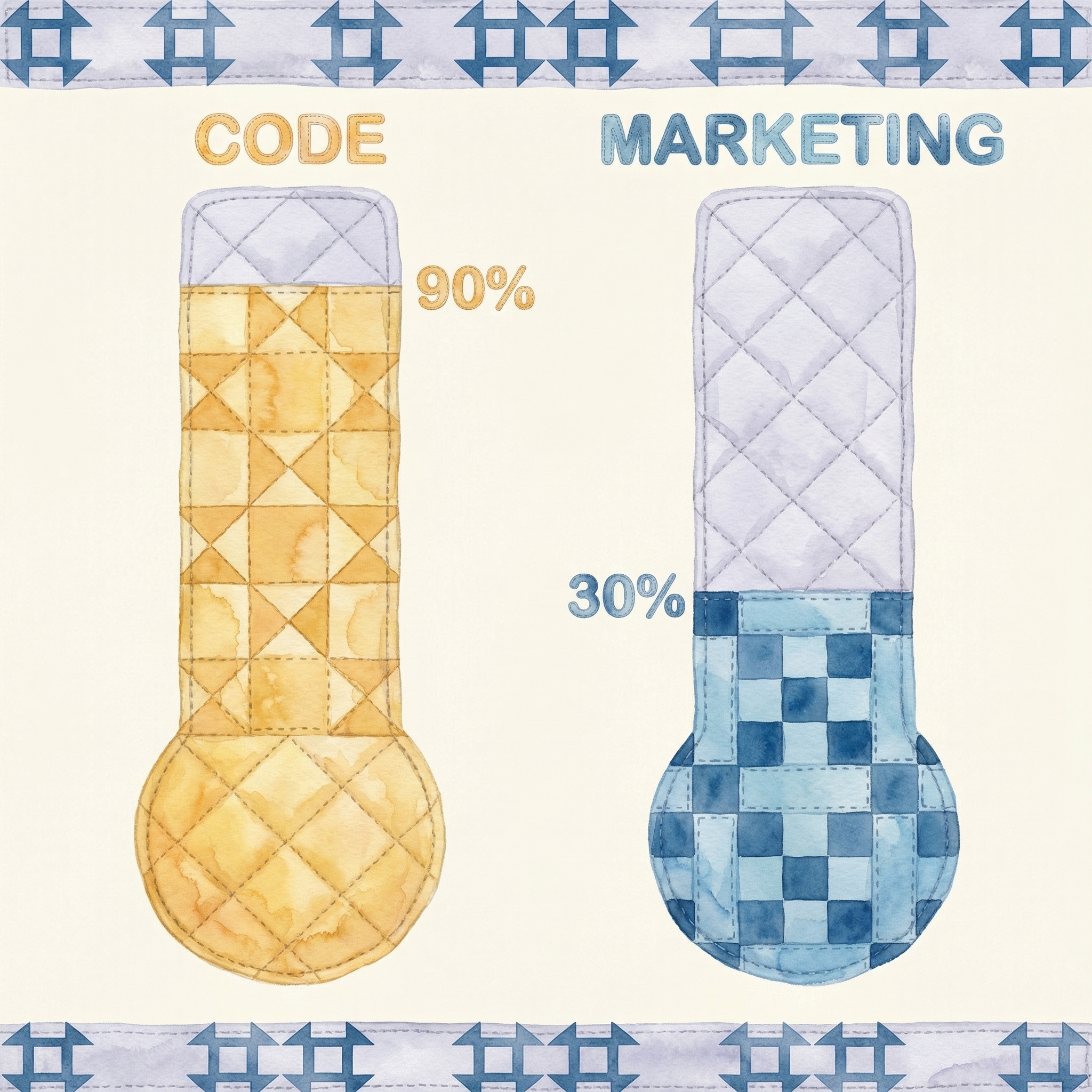
These three properties — standardized interface, automated verification, and programmable deployment — form what we might call the "agentability surface" of a domain. Code scores perfectly on all three. Marketing, as we will see, scores near zero.
3. The Marketing Parallel: Briefs to Assets to Deployment
At a high level, marketing campaign execution follows a pipeline that mirrors software development remarkably well. A brief (the "spec") defines the campaign's goals, audience, channels, and messaging. Creative production (the "implementation") generates the emails, landing pages, ads, and sales collateral. Deployment (the "release") pushes those assets into the platforms where they actually reach audiences.
AI has already transformed the middle layer. Tools like Jasper, Copy.ai, Midjourney, and the native AI features in Canva and Figma have made creative production dramatically faster. A 2025 industry survey found that 91% of marketing professionals use AI in some capacity. But here is the critical number: 80.6% of that usage remains in "assist-only" mode — generating drafts, suggesting variations, creating image options that a human then manually places into the correct platform.
The deployment layer remains almost entirely manual. To launch a campaign in HubSpot, a human operator navigates the email editor, configures send settings, builds or selects a contact list, creates an associated workflow, sets up lead scoring rules, builds a landing page, connects form submissions to lifecycle stage changes, and schedules the send. Each of these steps happens in a graphical interface designed for human eyes and mouse clicks. Multiply this across the six to twelve platforms in a typical enterprise marketing stack — the MAP, the CRM, the CMS, the ad platforms, the ABM tool, the sales enablement system — and you have a deployment surface that is orders of magnitude more complex than git push.

This is the bottleneck. Not ideation. Not creative. Deployment. Marketing teams can generate more content than ever before, but the last mile — getting that content live, configured correctly, targeted properly, and tracked end-to-end — still requires the same number of human hours it did in 2020. The backlog grows while the deployment throughput stays flat.
4. Why Marketing Is Harder: The Four Structural Barriers
Understanding why marketing has not yet had its "Claude Code moment" requires examining four structural barriers that do not exist in software engineering.
Barrier 1: Bespoke stacks
No two companies configure their marketing platforms the same way. Custom properties, naming conventions, folder structures, workflow architectures, lifecycle stage definitions, lead scoring models — all of it is unique. A typical mid-market HubSpot instance contains 200+ custom properties, 50+ active workflows, and dozens of templates with custom modules. An AI agent cannot make any assumptions about the environment it is deploying into. In code, the agent assumes git. In marketing, the agent must first discover and map an entirely unique configuration landscape.
Barrier 2: No test suite
When an AI agent generates an email campaign, there is no automated system that verifies the subject line meets character limits, the personalization tokens resolve correctly for every contact in the list, the CTA links point to live pages, the suppression rules are applied, the UTM parameters are correctly structured, and the send time aligns with recipient timezones. Each of these checks is performed by a human clicking through screens. Software has had automated testing for decades. Marketing has nothing equivalent.
Barrier 3: Brand subjectivity
Code correctness is largely objective. A function either returns the right value or it does not. The test either passes or fails. Brand compliance is inherently subjective. Is this headline "on brand"? Does this image "feel right" for our audience? Is the tone appropriate for this segment? These are judgment calls that resist binary automation. Even with detailed brand guidelines, reasonable people disagree about whether a specific piece of creative meets the standard.
Barrier 4: Fragmented APIs
HubSpot, Marketo, and Salesforce Marketing Cloud all offer APIs, but these APIs were designed for data synchronization and integration — not for full campaign orchestration. Creating an email via the HubSpot API requires constructing raw HTML, setting properties through specific endpoints, associating the email with campaign objects, and configuring send parameters through a sequence of calls that is far more complex than the visual drag-and-drop editor. The APIs are incomplete (many UI features have no API equivalent), inconsistent across platforms, and change frequently. This is the opposite of git, where the interface has been stable for over a decade.
The fragmentation tax: An enterprise marketing team running HubSpot, Salesforce, LinkedIn Ads, Google Ads, Drift, 6sense, and Highspot must navigate seven different APIs (where they exist), seven different authentication schemes, seven different data models, and seven different deployment semantics to launch a single integrated campaign. A software team deploying the same campaign's backend code uses one interface: git.
5. The Infrastructure Catching Up: Sandboxes, Browser Agents, and APIs
Despite these structural barriers, 2025 and 2026 have produced a wave of infrastructure that is systematically closing the gap. Three categories of technology are converging to make marketing deployment agentable.
Agent sandboxes
E2B, Cloudflare, and Docker all launched agent sandbox platforms between 2025 and 2026. These environments give AI agents isolated, ephemeral compute environments where they can execute actions — including API calls to marketing platforms — without risking production data. This is the equivalent of a staging environment for code. An agent can build a campaign in a sandbox HubSpot instance, validate it, and then promote it to production. The sandbox pattern is what made autonomous code deployment safe; it will do the same for marketing.
Browser automation agents
For platforms where APIs are incomplete, browser automation is emerging as a bridge technology. The open-source browser-use library, Vercel's agent-browser project, and Anthropic's computer use capability all enable AI agents to interact with web applications through the same interfaces humans use — clicking, typing, navigating. While browser automation is inherently more fragile than API calls (UI changes break scripts), it dramatically expands the surface area of what agents can deploy. A browser agent can navigate a marketing platform's UI to configure settings that have no API equivalent.
API maturation
The marketing platforms themselves are investing heavily in API coverage. HubSpot's 2025-2026 API expansions added endpoints for workflow creation, email template management, and campaign object orchestration that did not exist two years ago. Salesforce's Marketing Cloud APIs are similarly expanding. The platforms recognize that their future depends on being programmable, not just visual — because the agents are coming whether the APIs are ready or not.
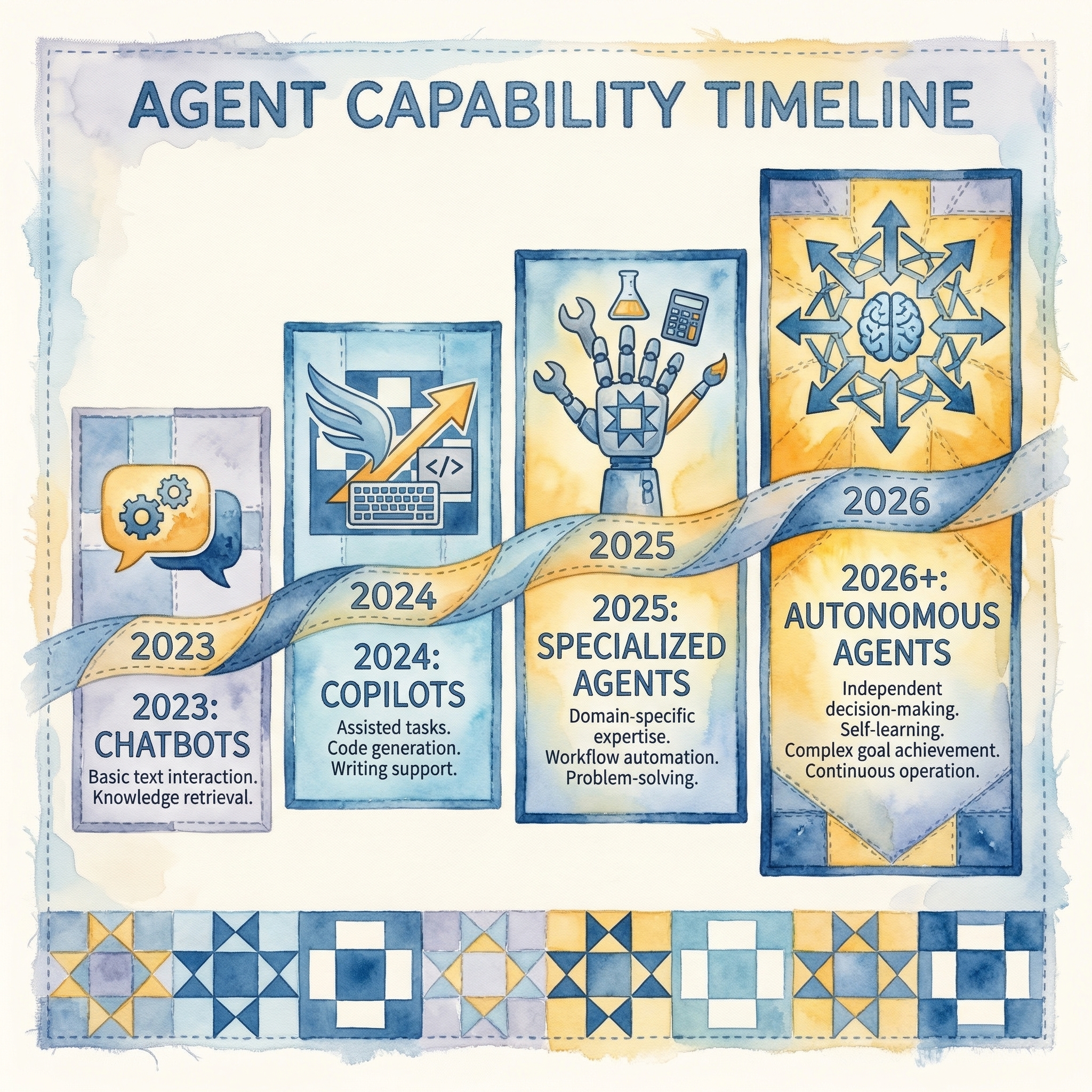
The convergence of these three layers — sandbox environments for safe testing, browser agents for UI-bound tasks, and maturing APIs for programmatic deployment — creates, for the first time, a viable infrastructure stack for autonomous marketing campaign execution. It is not as clean as git plus CI/CD. It will not be for years. But it is functional enough to start replacing the human hours currently spent on mechanical deployment tasks.
6. The $200B Bet: Where the Money Is Going
Gartner's projection of $201.9 billion in agentic AI spending in 2026 is not evenly distributed across use cases. The investment thesis follows a clear logic: the highest-value agent applications are in domains where (a) the manual labor cost is high, (b) the tasks are repetitive and semi-structured, and (c) the deployment infrastructure is just barely mature enough to support automation.
Marketing checks all three boxes. Global marketing spend exceeds $500 billion annually, and a significant portion of that goes to the human labor required for campaign execution — the ops specialists, the email developers, the landing page builders, the ad platform managers. These are skilled roles performing repetitive configuration tasks across fragmented tools. They are expensive, hard to hire, and burning out under growing campaign backlogs.
"The marketing operations bottleneck is not a people problem. It is an infrastructure problem being solved by people. Every hour a marketing ops specialist spends clicking through HubSpot's workflow builder is an hour that should be handled by an agent interacting with HubSpot's API." — internal analysis from a growth-stage marketing automation company
The venture capital flowing into marketing AI has shifted accordingly. In 2023-2024, funding went to content generation tools. In 2025-2026, the capital is moving downstream to deployment and orchestration — the companies building the infrastructure to take AI-generated content and actually get it live across platforms. This is the same pattern that played out in coding: first generation (Copilot), then deployment (Claude Code, Cursor agents, Codex).
Market sizing the opportunity: If agentic AI captures even 10% of the manual campaign execution labor currently performed by marketing teams globally, that represents a $50B+ market. For context, the entire marketing automation platform market (HubSpot, Marketo, Salesforce MC, etc.) was valued at approximately $6.6 billion in 2025. The execution layer dwarfs the platform layer because execution is where the human hours actually go.
7. What the Marketing Agent Stack Looks Like
The emerging architecture for autonomous marketing campaign deployment mirrors the software CI/CD pipeline but adapts it for the realities of marketing's fragmented landscape. Here is what the stack looks like in practice.
Brief ingestion layer. The agent receives a campaign brief — either from a human-written document, a structured form, or extracted from a strategy meeting transcript. Natural language understanding parses the brief into structured parameters: target audience, channels, messaging pillars, timeline, KPIs, and brand constraints.
Configuration discovery. Before generating anything, the agent maps the target environment. It reads the existing HubSpot (or Marketo, or Salesforce) configuration via API — custom properties, active workflows, template libraries, list structures, naming conventions. This is the equivalent of an AI coding agent reading the codebase before writing new code. Without this step, the agent generates assets that do not fit the environment.
Asset generation. With the brief parsed and the environment mapped, the agent generates campaign components: email copy and HTML, landing page content and structure, ad copy variants, sales enablement materials, workflow logic, and list segmentation criteria. Each component is generated to fit the discovered environment — using existing templates, respecting naming conventions, referencing valid custom properties.
Validation layer. Generated assets pass through a validation framework that checks structural correctness (valid HTML, correct merge tokens, live URLs), platform constraints (character limits, image dimensions, API schema compliance), and brand rules (tone analysis, terminology checks, style guide alignment). This is the marketing equivalent of a test suite — imperfect, but far better than no automated verification.
Human review gate. A human reviews the validated campaign in a staging environment. This is not a human clicking through thirty screens to check technical details — those have already been verified. The human reviews strategic alignment, creative judgment, and anything the validation layer flagged as requiring subjective assessment. The review surface is dramatically smaller than the current manual process.
Deployment. Approved campaigns deploy via API calls (where available) and browser automation (where necessary) into the production marketing platforms. Each deployment action is logged, reversible, and auditable. Post-deployment monitoring tracks deliverability, engagement signals, and any errors that the validation layer missed.
This is the pipeline that the agentic marketing stack is evolving toward. Companies like CharacterQuilt are building it now, learning from every campaign deployment what the validation layer needs to catch and where the API gaps still require browser-based workarounds.
8. Predictions: 2026-2028
Based on the trajectory of coding agents (which went from autocomplete to autonomous deployment in roughly three years) and the current state of marketing agent infrastructure, here is what the next two years likely hold.
2026 (now): Marketing agents handle single-platform, single-channel campaign deployment with human approval gates. Email campaigns in HubSpot, landing pages in WordPress, ad campaigns in Google Ads — each deployed by an agent that understands one platform deeply. Cross-platform orchestration still requires human coordination. This is roughly where coding agents were in late 2024: capable within a defined scope, but not yet able to operate across an entire system autonomously.
2027: Cross-platform orchestration becomes viable. A single agent (or coordinated agent system) takes a campaign brief and deploys across the MAP, CMS, ad platforms, and sales enablement tools in a coordinated sequence. Validation frameworks mature to catch 80%+ of deployment errors automatically. Human review shifts from checking mechanical correctness to evaluating strategic judgment. Marketing ops roles begin transforming from "campaign builders" to "agent supervisors" — the same transition that happened in software engineering when developers went from writing all code to reviewing agent-generated code.
2028: Autonomous campaign cycles. Agents not only deploy campaigns but monitor performance, identify underperforming elements, generate and deploy optimizations, and report results — all within human-defined strategic guardrails. The marketing team sets objectives and brand constraints. The agent handles the execution cycle. Human intervention happens at the strategic layer (which audiences, which messages, which channels) rather than the mechanical layer (configuring workflows, building emails, setting up tracking). Campaign volume increases 5-10x while the human team stays the same size or shrinks.
This timeline is aggressive but consistent with the coding agent trajectory. The infrastructure barriers are real, but the economic incentive is enormous, and the convergence of sandbox platforms, browser automation, and maturing APIs is creating the conditions for rapid acceleration.
The Bottom Line
Software engineering was the first domain to experience full agentic transformation because its deployment infrastructure — git, tests, CI/CD — was already standardized and machine-addressable. Marketing is the next domain because it has the same pipeline structure (brief, create, deploy) with the same economic incentive (massive manual labor costs) but has lacked the deployment infrastructure to support autonomy.
That infrastructure is arriving now. The $201.9 billion in agentic AI spending projected for 2026 is not speculative — it is capital chasing a proven thesis (agents can deploy complex work products) in a domain that is finally ready to receive it (marketing platforms are becoming programmable). The teams that move first will not just execute faster. They will execute at a fundamentally different scale, deploying in hours what currently takes weeks, and compounding that advantage with every campaign cycle.
The coding agent revolution showed us what is possible when AI can deploy, not just generate. Marketing is next. The only question is whether your team will be deploying with agents or competing against teams that are.
If you are ready to move beyond AI-assisted content generation into fully deployed, agent-driven campaign execution, book a demo with CharacterQuilt and see what the next frontier looks like in practice.